
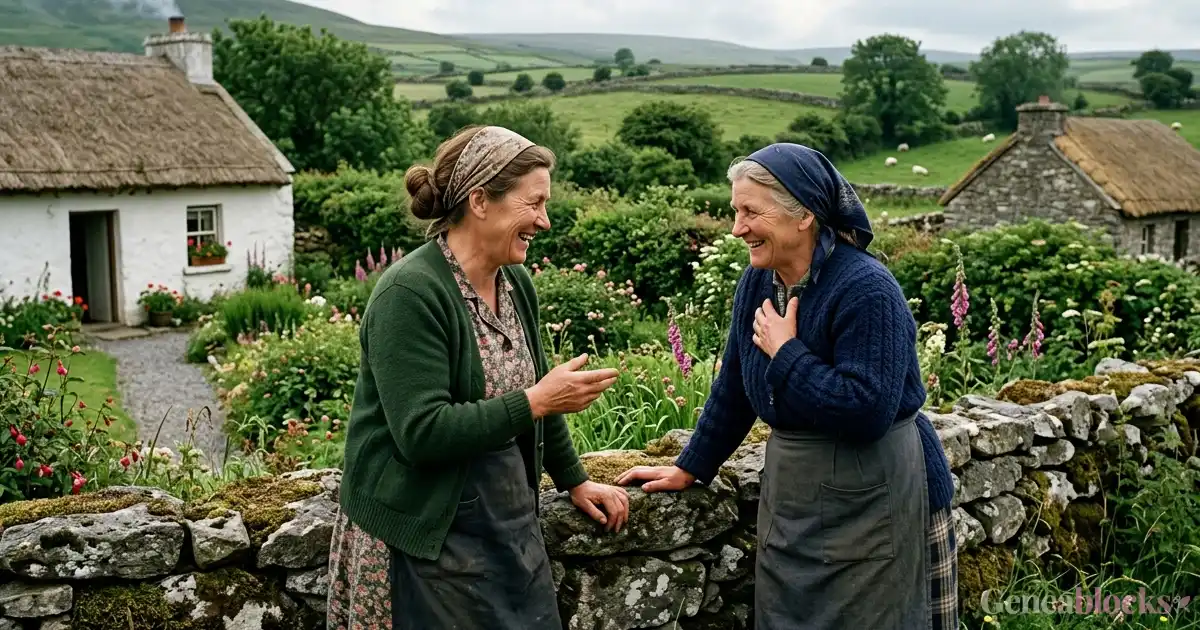
Most people begin genealogy research the obvious way: they follow their direct line backwards, one generation at a time, collecting birth, marriage, and death records as they go. This approach works well — right up until it doesn't. At some point, usually several generations back, the direct evidence runs out. The records stop naming your ancestor clearly, or stop existing altogether. The family line hits a wall.
The instinct at this point is to search harder along the same line — to try different databases, different spellings, different date ranges. Sometimes that works. But experienced genealogists know that the more productive response is often to stop focusing on the ancestor entirely and start focusing on the people around them.
This is the core insight behind the FAN Club method, a term associated with the work of genealogist and educator Elizabeth Shown Mills. FAN stands for Friends, Associates and Neighbours — the full social world your ancestor inhabited. Researching that world systematically, rather than only mining it for incidental clues, is one of the most powerful techniques available to a genealogist working a difficult problem.
Why the people around your ancestor matter
People in earlier centuries — and to a considerable extent in all centuries — did not make major life decisions independently of their social networks. They married people from their own communities. They moved to places where someone they already knew had settled. They named their children after parents, siblings, and close friends. They witnessed each other's wills, stood as godparents at each other's baptisms, and were named in each other's estate inventories.
All of this means that the records of the people around your ancestor are not merely background noise — they are a parallel set of evidence about the same community, the same family networks, and in many cases the same individuals. A neighbour who moved from the same Irish county as your great-great-grandmother may have left a naturalisation record that names the town. A witness at your ancestor's marriage may have their own marriage record, ten years earlier, that supplies the parents' names your ancestor's record omits. The estate inventory of a man who owed your ancestor money may describe property that illuminates your ancestor's economic circumstances in ways their own records never do.
The FAN Club approach recognises this and turns it into a methodology: instead of treating these individuals as incidental characters, you research them as fully as you research your direct-line ancestor.
Identifying your ancestor's FAN Club
The first practical step is to gather every document you already have for your brick wall ancestor and read each one with a different question in mind. You are no longer looking for facts about your ancestor. You are looking for names.
Go through the documents systematically. In a census entry, note not just the household members but the names of the neighbours listed on the same page — the households immediately before and after in particular, since enumerators moved street by street, and proximity in the census often reflects proximity in life. In a marriage record, note the witnesses. In a baptism entry, note the godparents. In a will or probate record, note the witnesses, the executor, and anyone named as a beneficiary or a debtor. In a deed, note the witnesses and any adjacent landowners named in the boundary description.
Build a list of these names. Some will appear only once and may lead nowhere. Others will appear repeatedly — the same person witnessing a marriage, appearing as a near-neighbour in two consecutive censuses, and named as executor of your ancestor's will. Recurring names are significant. They indicate a sustained relationship, and that kind of relationship is exactly what you want to investigate.
Church records are particularly productive for this exercise. If your ancestor attended a specific congregation — Catholic, Methodist, Quaker, Lutheran, or any other denomination that kept its own registers — then the other members of that congregation were their community. The registers will show the same families appearing as witnesses and godparents for one another across decades, and tracing those families can open up a community portrait that your direct-line research alone could never provide.
What to look for when you research the FAN
Once you have your list of names, the research process is the same as it would be for any individual — with one important difference in emphasis. You are not trying to build a complete family tree for each person. You are looking for specific types of information that might shed light on your original problem.
Places of origin are often the most immediately useful. If you are trying to establish where an immigrant ancestor came from, and your ancestor's own records give only a country, check the naturalisation records, death certificates, and obituaries of their known associates. People who emigrated together — or who joined the same community in their new country — very often came from the same area. If three of your ancestor's neighbours can be placed in County Clare, and your ancestor lived among them for thirty years and appears to have arrived at the same time, the working hypothesis that they too came from Clare is well-founded and worth pursuing in the Irish records.
Maiden names and family connections are another fruitful category. Women in earlier records frequently disappear behind their married names, and their parentage can be very difficult to establish from their own records alone. But a woman's family — her parents, siblings, and cousins — often remained part of her social world after marriage. If you see the same unusual surname appearing as a witness at her marriage, as a godparent for her children, and as a neighbour in the census, there is a strong possibility that this person is a relative. Following that connection may give you the maiden name you have been looking for, or at least a strong hypothesis to test against the available records.
Timelines and movements can also be clarified through the FAN. If you are not certain when your ancestor arrived in a place, or when they left, the records of their associates can help bracket the dates. A neighbour who appears in the same township as your ancestor in 1851 but can be documented as having left for another county by 1855 may help you narrow down the period during which your ancestor was also present.
The FAN Club and naming patterns
One of the most underused applications of the FAN Club approach is in the analysis of naming patterns. In many cultures and periods, children were named according to fairly consistent conventions — after parents, grandparents, godparents, or close family friends. A child named after a godparent is an especially useful clue, because it implies a close enough relationship that the parents chose to honour that person in a lasting and visible way.
If your ancestor gave one of their children an unusual first name that does not appear anywhere else in the known family — a name like Jedediah, or Saoirse, or Bartolomeus — it is worth looking at the FAN Club for that name. Was there a neighbour, a godparent, or a fellow congregant with that name? If so, that individual may be a close relative, or at minimum a person of significance to the family whose own records might illuminate the ancestry you are trying to trace.
The same logic applies in reverse. If you find a name in a FAN Club member's family that matches an unusual name in your direct line, the connection is worth investigating. It may be a coincidence. It may also be a thread that, when pulled, unravels the brick wall.
Land and property records as FAN Club sources
Land and property records are among the most consistently informative sources for FAN Club research, because they record relationships between people in ways that vital records often do not.
In deed records, boundary descriptions name adjacent landowners — which means that anyone who owned land next to your ancestor appears in your ancestor's deeds whether or not they ever had any direct interaction with them. Over time, these adjacencies build into a picture of a neighbourhood. If the same family name appears on two sides of your ancestor's land for thirty years, and that family cannot be found in the direct-line records as a relation, it may nonetheless be one.
Probate records are particularly rich. When a will names your ancestor as a witness or an executor, that tells you something about the esteem in which they were held by the deceased. When a probate inventory lists your ancestor as a creditor — someone owed money by the estate — it places them in a documented economic relationship. And when an estate is divided among heirs and your ancestor receives a bequest, you have evidence of a relationship that may be familial even if it is not labelled as such.
For British and Irish research, tithe applotment books, Griffith's Valuation, and the various land tax records can place an ancestor in a specific townland alongside their neighbours at a given point in time. Working through those neighbours systematically — cross-referencing them against church registers, civil registration, and estate papers — is exactly the kind of FAN Club work that has resolved Irish genealogical problems that seemed permanently intractable.
When to deploy the FAN Club method
The FAN Club approach is not something you need to apply to every generation of every family line. It becomes most valuable in specific circumstances.
It is the right tool when your direct-line research has genuinely stalled — when you have exhausted the obvious records for your ancestor and found nothing further. It is also the right tool when your ancestor's records are sparse by nature: a woman who appears in records only as a wife and mother; a labourer who owned no property and left no will; an immigrant who arrived before the era of detailed passenger manifests. People who left few records of their own are often more visible in the records of the people around them than they are in any document that bears their own name.
It is also worth deploying early when you suspect that a common surname is causing confusion — when there are multiple men named John Murphy or Thomas Williams in the same parish at the same time, and you are not certain which one is yours. Mapping the FAN Clubs of each candidate can help distinguish them: if one John Murphy consistently appears in records alongside the same set of families, and another appears in a different social circle entirely, you have evidence for separating them that surname and dates alone cannot provide.
Keeping the FAN Club research organised
One practical challenge with FAN Club research is that it generates a great deal of material quickly. You are no longer tracking one family line — you are tracking several individuals in parallel, and the connections between them.
A dedicated research log for the FAN Club work is essential. Record each individual you are investigating, what prompted you to include them (which document named them, and in what capacity), and what you have found so far. Note negative searches as well as positive ones — knowing that you have already checked the 1851 census for a particular name and found nothing saves you from repeating that search six months later.
Some researchers find it useful to create a simple diagram showing the relationships between FAN Club members as they emerge — not a formal genealogical chart, but a rough map of who was connected to whom and by what kind of tie. Seeing the social network laid out spatially can make patterns visible that are not apparent when the same information is presented as a list of names and dates.
Good genealogy software can help considerably here. The ability to record individuals who are not on your direct line, link them to source documents, and note their relationships to your primary subjects — without losing track of who you are actually researching — makes a significant difference when a FAN Club investigation starts to grow.
The Geneablocks matcher can help you identify which type of brick wall problem you are facing before you begin — including whether a FAN Club approach is the most likely route through it, or whether the problem calls for a different strategy first.

