
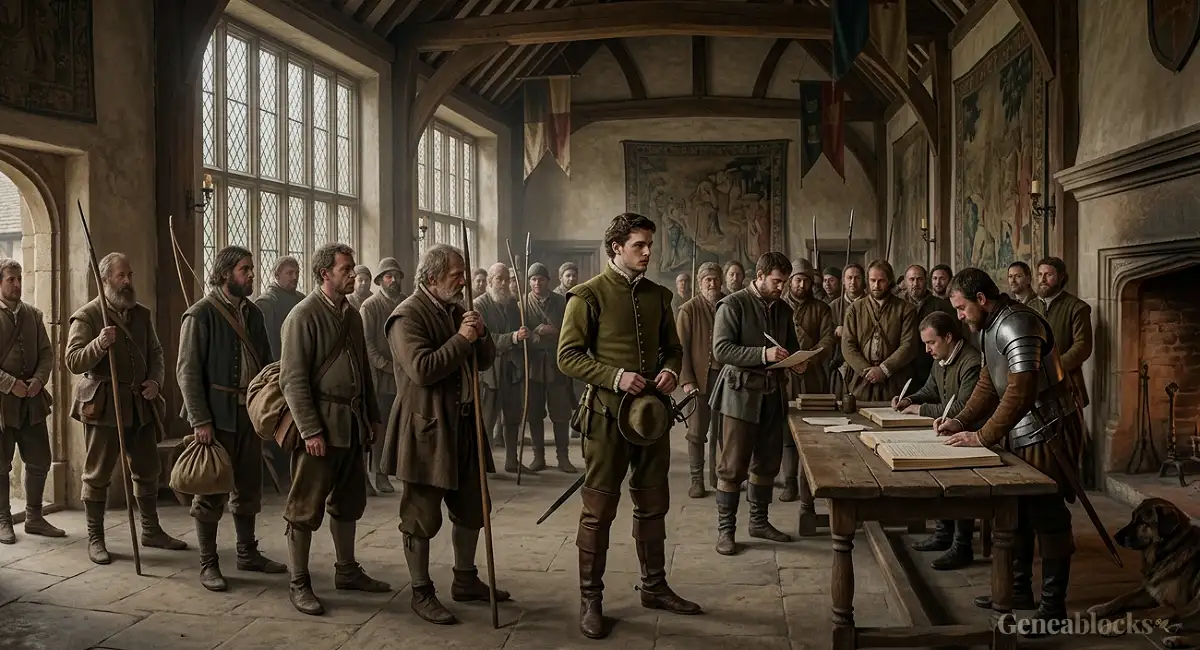
You've done something remarkable. You've traced your family back to the 16th century — a period most researchers can barely glimpse — and there he is: a name in a muster roll, standing in a parish, sword or bill in hand, assessed and certified. It feels like solid ground. Then you see the obstacle — other families share your surname in those same rolls. You just can't connect them to your line. Were they cousins? Neighbours who happened to share a name? A completely unrelated family that settled in the same area generations earlier? The muster roll, for all its age and atmosphere, won't tell you.
This article is about what you do next, because the muster roll is not the end of the road — it's a locating tool, and a remarkably precise one. It tells you where your ancestor was, roughly when, and sometimes hints at his wealth and standing. That information is the key that unlocks a whole ecosystem of 16th and early 17th-century records that most researchers never think to use.
First, Understand What You Are Actually Looking At
Before we talk about where to go next, it helps to understand exactly what a Tudor muster roll records — and what it doesn't.
The earliest surviving English muster roll dates from 1522 and is sometimes called the "Tudor Domesday." Ordered by Cardinal Wolsey, it was a nationwide survey of military and financial strength. Every man aged 16 to 60 in every hamlet, parish and village was supposed to attend, declaring on oath the value of his lands and goods and accounting for his weapons and armour ("harness"). The 1522 muster is unique in that it also recorded, in some areas, occupations and the names of lords of the manor.
Later musters — notably the well-documented national muster of 1569, called in response to rising tensions with Spain and Scotland — focused more on military readiness, listing able-bodied men by parish, often with equipment details. Musters continued into the Stuart period, generally covering the years 1522 to 1649.
Here is the critical thing for researchers to know: Tudor muster rolls are geographically arranged by hundred, then by parish. Your ancestor isn't floating in a county-wide list — he's standing in a specific community. That community is your research focus. Everything that follows builds outward from that parish.
One important caveat before you go further: survival of Tudor muster rolls is patchy. Not every county has complete coverage, and what survives may be held at The National Archives (particularly in the State Papers Domestic series, SP 12, for the Elizabethan period), at county record offices, or sometimes in local archive collections. The Gibson and Dell directory Tudor and Stuart Muster Rolls (1989) maps what survives and where it is held across the British Isles — if you haven't consulted it, your local library or a Society of Genealogists membership will get you access.
It's also worth knowing that estimates suggest a typical muster roll for this period may have omitted up to a third of the men it was supposed to record. An absence from the roll doesn't mean your ancestor wasn't there.
Step One: Cross-Reference with the Lay Subsidy Rolls
If muster rolls and lay subsidy rolls were people, they'd be neighbours who rarely spoke but had a lot in common.
Lay subsidy rolls are taxation records covering England from the 12th to the 17th centuries, and the Tudor subsidies of 1524–1525 in particular overlap almost perfectly with the 1522 muster in both population and geography. Where the muster recorded military capacity, the subsidy recorded taxable wealth — and because both documents were arranged by parish, the same names often appear in both, sometimes within two or three years of each other.
This is enormously useful when you're trying to distinguish between two families of the same surname in the same area. A man assessed for substantial lands in the 1522 muster and again in the 1524 subsidy is very likely the same individual. The subsidy rolls frequently covered middling and higher-status householders — exactly the population most likely to appear in muster rolls.
The National Archives E 179 database is the starting point for locating surviving subsidy records by county, hundred and year range. Many county record societies have also published transcribed subsidy rolls, and British History Online carries digitised versions for some counties and periods.
One practical note: if you find your surname in both document types, compare the valuations. A man assessed in the muster at £5 in goods and in the subsidy at a similar figure is likely the same person. A name that appears in the subsidy but not the muster may represent a man who was over 60, or was omitted — both possibilities worth investigating.
Step Two: Work the Manorial Records
This is where many researchers can make a significant leap, and where any connection to nobility that your research may have hinted at becomes particularly important.
Many Tudor parishes were manors, administered by a lord whose court regulated everything from land inheritance to petty disputes between tenants. The court rolls, surveys, rentals and leases generated by these courts can name the same families across multiple generations — sometimes going back well before parish registers begin in 1538.
Manorial records can tell you:
- Who held land in the parish and when tenancies changed hands (often at death, marriage or sale)
- Family relationships, because leases frequently named which family members would inherit a tenancy
- The approximate date of death of a copyholder, since the succession of the heir to the tenancy was recorded through the court
- Details of disputes — useful for establishing who knew whom and who lived where
If your ancestor appeared in a muster roll with a significant land valuation, there is a reasonable chance he was a copyhold tenant of the manor, and his family may appear in court rolls going back decades before the muster.
The Manorial Documents Register, held at The National Archives, is the key finding tool here. It identifies which manorial records survive for a given parish and where they are held — many are at county record offices, but some remain in private family archives or with university colleges (Oxford and Cambridge colleges, in particular, held extensive manorial estates). Be aware that manorial records were written in Latin until 1733, so earlier documents will require either Latin skills or a professional record agent.
Step Three: Don't Overlook the Parish Registers — But Read Them Differently
Parish registers began in England in 1538, just sixteen years after the earliest muster rolls. If your ancestor appears in a 1569 muster, his baptism record may well exist.
The critical shift in mindset for 16th-century register research is this: you are not just looking for your direct line. You are mapping the entire surname community in that parish and in neighbouring parishes. Every baptism, marriage and burial entry for anyone sharing your ancestor's surname — or a plausible variant of it — within a reasonable geographic radius is a potential data point.
This is exactly the approach of a one-name study, and it pays dividends at this period. A marriage entry linking a man of your surname to a woman from a neighbouring parish might open up that second family in a completely new direction. A cluster of burials in a single decade might represent a branch that died out — and whose surviving siblings dispersed elsewhere.
Surname spelling in the 16th century was not standardised. Clerks recorded what they heard, in their own hand, in their local dialect. A name that looks fixed on the muster roll may appear as several quite different spellings in the register — and vice versa. Before you conclude a name isn't there, work through the phonetic possibilities systematically: consider dropped or added initial H, vowel substitutions, and the way the surname might have sounded to someone from the specific regional accent of that county.
Step Four: The 1524–1525 Lay Subsidies and the Question of Wealth
We mentioned the subsidy rolls above as a cross-reference tool, but they deserve a second mention in their own right because of something they do that the muster rolls don't: they give you a relative sense of economic standing.
In the 1524–1525 subsidies, men were taxed on either their income from land or the value of their moveable goods (whichever was higher). The rates were graduated. A man assessed on goods worth £20 or more was in comfortable circumstances; one assessed on wages alone was at the lower end of the economic scale.
If you are trying to establish whether two men of the same surname in the same area were related — and if so, which was the senior branch — the relative wealth assessments in the subsidy can be genuinely helpful. A significant difference in assessed wealth between two men of the same name in adjacent parishes might suggest one held the original family property while another was a younger son who had set up independently.
Step Five: If There's a Possible Nobility or Gentry Connection
This deserves special attention because it opens a set of records that simply don't exist for ordinary yeoman or labouring families.
If your ancestor appears in a muster roll with a substantial land valuation, or if family tradition or independent evidence suggests a connection to gentry, several additional avenues become available:
Heralds' Visitations were periodic inspections carried out by the College of Arms to verify which families were entitled to bear a coat of arms. Conducted roughly every generation between 1530 and 1688, the visitation records for each county list armigerous families with pedigrees that were submitted and certified. If your surname family had any claim to gentility, there's a reasonable chance they appear. The visitations have been published by the Harleian Society and many are available through county record offices and university libraries.
University and Inns of Court records are often overlooked but can be invaluable. The sons of gentry and prosperous yeoman families attended Oxford and Cambridge from the Tudor period onwards, and the alumni records of both universities have been published in extenso. The Inns of Court (Gray's Inn, Lincoln's Inn, Inner Temple and Middle Temple) similarly maintained admissions registers, and a young man of the surname appearing at one of the inns in the late 16th century may be the key link between your documented ancestor and the wider surname family you're trying to connect.
College of Arms records and published county histories (the Victoria County History series, where available, and older antiquarian county histories) may contain family pedigrees compiled in the 17th and 18th centuries that incorporate earlier oral tradition or estate records no longer extant.
Step Six: Wills and Probate
Wills from the 16th century survive in surprising numbers and are one of the most underused resources for this period.
Before 1858, probate was administered by the Church, and the relevant court depended on where the deceased held property. The Prerogative Court of Canterbury (PCC) handled estates with property in more than one diocese, while archdeaconry and consistory courts dealt with more local estates. PCC wills from 1384 to 1858 are now available through The National Archives' Prob 11 series, searchable and downloadable online.
For the researcher trying to connect surname families in the same area, a 16th-century will is invaluable because it typically names:
- The deceased's wife, children and sometimes grandchildren
- Brothers, sisters and their children (particularly where property is being divided)
- Neighbours and friends who acted as witnesses or overseers
A will naming a brother or cousin with the same surname as your documented ancestor may be the connection you've been looking for. Even a will that doesn't directly help may establish that a particular branch of the family had died out in a given parish by a certain date — narrowing your search elsewhere.
A Note on What You Won't Find
It would be dishonest to suggest these records will always yield results. Tudor England was a largely illiterate society in which ordinary working men could live and die without generating much documentary trace beyond a muster certificate and a burial entry.
The records above are most productive for men of some property — those assessed in the muster with land or goods of any significance. A man assessed only at the very minimum, or appearing simply as one of a group of unnamed "able men," may leave very little trace elsewhere. In those cases, the best strategy is often to work forward from the muster — tracking the surname in parish registers, later subsidy rolls, and the hearth tax of 1662–1674, building up a picture of the family's movements and economic trajectory over time, and hoping that a more document-rich generation opens a door back to the 16th century.
Where to Start Looking
- The National Archives: muster rolls in SP 12 (State Papers Domestic, Elizabeth I) and WO series; E 179 database for subsidy records; PCC wills online
- Gibson & Dell, Tudor and Stuart Muster Rolls (1989): the essential directory of surviving records by county
- British History Online: digitised subsidy rolls, county histories, Victoria County History
- County record offices: the first port of call for locally held muster rolls, manorial records and archdeaconry probate
- The Manorial Documents Register (accessible via The National Archives): identifies surviving manorial records by parish
- The Harleian Society publications: heralds' visitation pedigrees by county
- Alumni Oxonienses and Alumni Cantabrigienses: published university admissions records
The muster roll found him. Now it's time to find out who he really was.

