
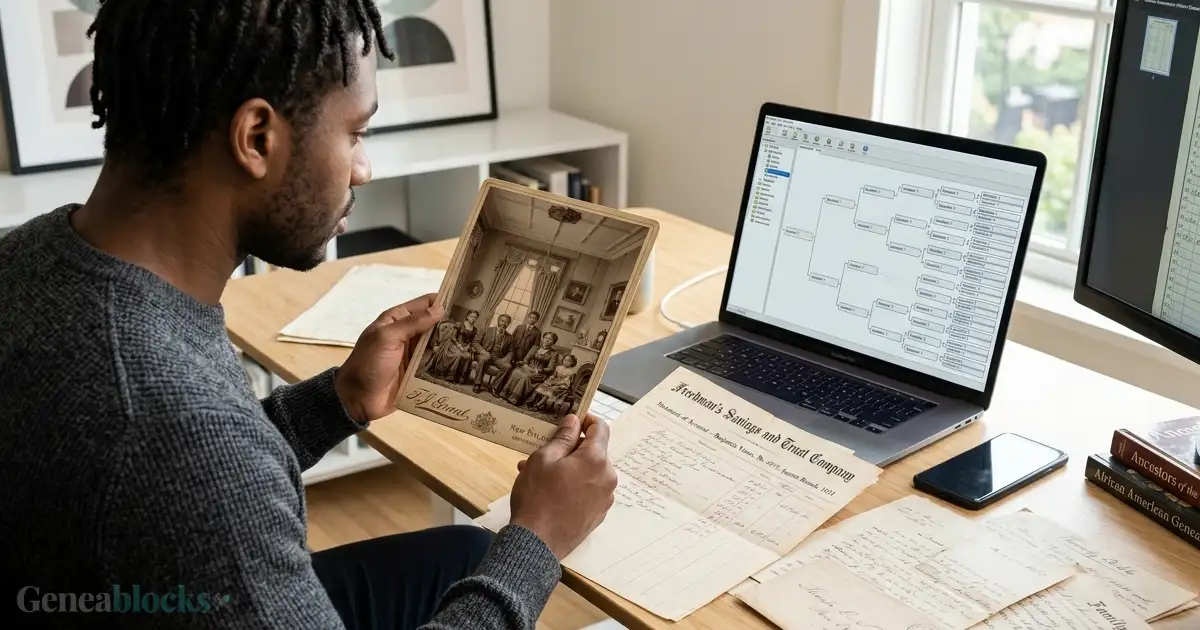
The 1870 federal census was the first in United States history to record all people by name regardless of race. For the millions of African Americans whose ancestors were enslaved, it represents the earliest point at which most families appear in the official record — named, enumerated, and acknowledged as individuals rather than as property. It is a landmark. It is also, for many researchers, where the trail appears to end.
The appearance is deceptive. The records that document life before 1870 are different in character — they were not created to serve the people they recorded, and working with them requires confronting that directly — but they exist, and they are more accessible today than at any previous point in history. Thousands of researchers have already used them to carry their family trees back before emancipation, sometimes by several generations.
This guide does not minimise how the records were created or what they represent. Slavery was a system that deliberately denied African Americans their identity, their family connections, and their history. The records that survive from that period reflect that system. But those same records contain real names, real ages, real relationships — and for many families, they are the bridge back to ancestors who would otherwise be entirely invisible.
Why 1870 is the wall — and why it is not the end
Before 1865, enslaved people were legally considered property under the laws of the slaveholding states. The federal census slave schedules of 1850 and 1860 recorded enslaved people not by name but as a sequence of numbers: age, sex, and a colour designation, listed under the name of the enslaver who held them. There are no surnames, no given names, no family relationships in those columns. For a researcher looking for a named ancestor, the slave schedules appear to offer nothing.
This is where the myth of the impassable wall comes from, and it is understandable. But the slave schedules are not the only records from this period, and they are not even the most useful ones for genealogical purposes. The key insight that unlocks pre-1870 research is this: to find your ancestor before 1870, you first need to identify the person who enslaved them. Once you have that name, a substantial body of records becomes available.
Finding the enslaver is not always straightforward, but there are reliable routes to it — and the records created in the years immediately after emancipation are often the place to start.
The Freedmen's Bureau: the most important starting point
The Bureau of Refugees, Freedmen, and Abandoned Lands — known universally as the Freedmen's Bureau — operated from 1865 to 1872, established by Congress to support formerly enslaved people and poor white Southerners in the immediate aftermath of the Civil War. In the process of doing that work, it created millions of records — and those records are among the most genealogically valuable documents in American history.
The Bureau's records include labor contracts between formerly enslaved people and their employers, marriage registers formalising relationships that had no legal standing under slavery, hospital and medical records, ration and issue records, letters written on behalf of freedpeople trying to locate family members from whom they had been separated, and records of claims and complaints. The labor contracts are particularly useful for genealogical purposes because they often name the employer — frequently the former enslaver — and list the formerly enslaved individuals by name along with family members working alongside them.
Nearly 1.8 million names from the Freedmen's Bureau records have been indexed and are now searchable free of charge at FamilySearch, in a project completed through the work of volunteer indexers over several years. The Smithsonian's National Museum of African American History and Culture (NMAAHC) also maintains a search portal. If your ancestor appears in these records, you will very likely find not only their name but the name of their former enslaver — which is the key that unlocks the next phase of research.
The Freedman's Bank records
The Freedman's Savings and Trust Company, established in 1865, operated branches across the South and in several Northern cities until its closure in 1874. It encouraged formerly enslaved people to open savings accounts, and in doing so it collected something remarkable: detailed personal information that no other record of the period routinely captured.
The account registers asked depositors for their name, age, complexion, place of birth, place raised, the name of their former enslaver, the names of their parents, the names of their siblings, the names of their spouse and children, and details of any military service. Not every entry is complete, but many are extraordinarily detailed — a biographical snapshot of an individual's life and family connections at the moment of emancipation.
The Freedman's Bank records are searchable free at both FamilySearch and Ancestry. If your ancestor opened an account, this single document may answer questions that would otherwise require months of research across multiple sources. It is one of the first places to search.
Researching the enslaver's records
Once you have identified the likely enslaver — through the Freedmen's Bureau, the Freedman's Bank, a shared surname, community knowledge, or other means — the records they left behind become your primary source for the period before emancipation.
Wills and probate records are often the most informative. When an enslaver died, their estate was inventoried and divided among their heirs, and enslaved people were listed as part of that estate. Wills frequently name enslaved individuals — sometimes with ages, sometimes with family relationships noted, occasionally with considerable personal detail — and they may record the transfer of individuals from one generation of an enslaving family to another, which can help you trace an ancestor's history backwards through time. Probate records are held at county courthouse level and many have been microfilmed or digitised.
Plantation records and farm journals, where they survive, can be extraordinarily detailed. Some enslavers kept careful records of the people they held — recording births, deaths, medical treatments, work assignments, and the movement of individuals between properties. These records are held variously by state archives, university libraries, and historical societies, and their survival is uneven. The Southern Historical Collection at the University of North Carolina and the Duke University Libraries are among the most significant repositories. Finding aids are increasingly available online.
Estate inventories, taken at the time of an enslaver's death, list enslaved people alongside other property with assigned valuations. While the context is deeply dehumanising, these inventories can establish that a named individual was held by a specific enslaver at a specific time, and cross-referencing them with other documents can begin to build a biographical picture.
Deeds of sale recorded the transfer of enslaved people between buyers and sellers, and are held in county deed books. They sometimes include a name, age, and a brief physical description of the individual transferred. These records are sobering to work with, but they can establish a named individual's existence and location at a documented point in time.
The slave schedules: cross-referencing for a match
The 1850 and 1860 federal census slave schedules recorded enslaved people without names, but they are not without genealogical use. Once you know the name of the likely enslaver, you can find their entry in the slave schedule and examine the age and sex profile of the people they held. Cross-referencing those profiles against what you know of your ancestor from the Freedmen's Bureau or Freedman's Bank records — their age at emancipation, the names and ages of family members — can produce a plausible match and carry your research back another decade or two.
This is not proof in the documentary sense, but it is legitimate genealogical reasoning: a well-reasoned hypothesis, clearly documented, that places a probable ancestor in a specific household at a specific time. Combined with other evidence, it contributes to the family history even where certainty is not achievable.
Civil War records and the United States Colored Troops
Approximately 180,000 African American men served in the United States Colored Troops (USCT) during the Civil War, and the records created by their military service are among the most detailed personal documents of the period. Compiled military service records, pension files, and regimental records can provide a formerly enslaved soldier's name, age, physical description, birthplace, and — in pension files, which often continued to be updated for decades after the war — information about family members, marriages, and post-war life.
USCT records are held by the National Archives and Records Administration (NARA) and many are accessible through Ancestry and Fold3. Pension files in particular can run to dozens of pages and contain testimony from the veteran, their widow, and witnesses — a rich biographical source that extends well beyond the military service itself.
The Southern Claims Commission
Less well known than the Freedmen's Bureau but potentially very useful, the Southern Claims Commission operated from 1871 to 1880 to evaluate claims from Southern Unionists seeking compensation for property taken by Union forces during the war. African Americans filed a significant number of these claims, and the case files — which include testimony from the claimant and from witnesses — can contain detailed personal and family information, including references to life before emancipation.
The records are held at NARA and have been partially indexed. They are worth searching if your ancestor lived in a Southern state and may have had Union sympathies or contact with Union forces.
Free African American records before 1865
Not all African Americans in the antebellum period were enslaved. A significant free Black population existed in both the Northern and Southern states, and their records are considerably more accessible than those relating to enslaved people. If your family history includes the possibility of free ancestry before the Civil War, it is worth searching the pre-1870 census records directly — free people of colour were enumerated by name in the 1850 and 1860 censuses, and in earlier censuses by household.
Free African Americans also appear in church records, tax lists, voter registrations where applicable, and in the records of organisations such as the African Methodist Episcopal Church, which maintained congregations across the country from the early nineteenth century. In some Northern states, records of free Black communities are well preserved and relatively accessible.
DNA and the African Diaspora
DNA testing has become an important tool for African American genealogical research, and not only for breaking through the 1870 wall. It offers routes to family connections that documentary research cannot always provide — both within the United States and beyond it.
Autosomal DNA testing and projects such as the African American DNA Roots Project and the African American and Genealogy Society (AAHGS) have helped thousands of researchers identify family lines that no surviving document records. Connecting with DNA matches who have already traced their own trees back before 1870 is one of the most effective strategies available — their documented research becomes a bridge into your own.
Y-DNA testing traces the direct paternal line and can sometimes identify an African ethnic or regional origin for that line — useful for researchers who want to trace ancestry to the continent of Africa itself rather than stopping at the point of enslavement. Mitochondrial DNA does the same for the direct maternal line. AfricanAncestry.com specialises in this area and has built reference panels specifically designed for African American researchers.
It is worth noting that the transatlantic slave trade brought enslaved people from a wide range of West and Central African origins — the Slave Voyages database documents this trade in extensive detail and can help researchers understand the probable geographic origins of ancestors brought to specific parts of the Americas during specific periods. This is population-level rather than individual research, but it provides meaningful context for DNA results and family history.
Caribbean and other diaspora connections
African American family history does not always run in a straight line from Africa to the American South. The transatlantic slave trade moved people through the Caribbean — particularly Jamaica, Barbados, Trinidad, and other islands — and some families have ancestry that passed through the Caribbean before arriving in North America. Others have roots in the Gulf Coast or in Spanish and French colonial territories that later became American states.
If your research suggests possible Caribbean connections — through DNA matches, family tradition, or records that indicate origins outside the Southern states — it is worth exploring the records of those territories. The Colonial Slavery database, the Caribbean Genealogy Library, and the archives of individual island nations hold records that can extend research into this dimension of the diaspora. FamilySearch has also been active in digitising Caribbean records and is a useful starting point for this branch of the research.
Oral history and community knowledge
In African American families, oral tradition has long carried information that no official record preserved. Names, places, stories of separation and reunion, the memory of a specific plantation or county — these are genealogical evidence, and they deserve to be treated as such.
If you have older relatives who carry family stories, record those conversations. A name remembered, a county mentioned, a story about an ancestor's occupation or personality, can be the clue that points documentary research in the right direction. Oral history is not infallible — dates drift, names change in the telling — but neither is any other source. It is one thread among many, and sometimes the most direct one.
Community and church records from historically African American institutions — particularly Baptist and Methodist congregations that served Black communities from the early nineteenth century onwards — are also worth seeking out. These records are held at varying levels of preservation, but where they survive they can provide baptism, marriage, and burial information that extends the documentary record considerably.
A note on the research itself
Researching ancestry through the records of slavery requires a particular kind of patience — not only with the records themselves, which can be incomplete, indirect, and painful to read, but with the process. Progress is rarely linear. A promising lead in a probate record may not resolve cleanly. A name in a labor contract may match two or three possible individuals in the slave schedules. The evidence builds incrementally, and the standard of proof is reasoned probability rather than documentary certainty.
That is not a failure of the research. It is an honest reflection of what slavery did to the documentary record. The families are real. The ancestors existed. The work of finding them — even partially, even provisionally — is a genuine act of recovery, and it matters.
If you are at the beginning of this research, the Geneablocks matcher can help you identify the specific nature of the wall you are facing and suggest the most relevant starting strategies. The 1870 wall is one of the most documented brick walls in genealogy, and the community of researchers who have worked on it is large, generous, and increasingly well resourced. You are not working alone.

